Special Offer: Take Advantage of North Dakota’s 50% REAP Grant Today
Solar Power for Off-Grid Living a Viable Option in North Dakota

Solar, Battery Storage and Generator Power for Energy Independence
For rural homes, farms and businesses in North Dakota, connecting to the electric utility isn’t always the most practical or economical way to obtain reliable power.
In remote locations, extending utility service can cost tens of thousands of dollars—and sometimes considerably more. When faced with a large utility-extension cost, it makes sense to compare that expense with the cost of installing an independent energy system that produces and stores electricity on the property.
Wind and Solar World designs off-grid and energy-independent systems using solar generation, Enphase microinverters, Enphase battery storage, Enphase system controls and backup generator support.
We’ve been installing renewable-energy systems in North Dakota since 2007 and understand that an off-grid system here has to be designed for North Dakota—not for California, Arizona or an ideal summer day.
When Does Going Off-Grid Make Sense?
Off-grid power can be particularly attractive when utility service is unavailable or expensive to bring to a property.
A rural homeowner might be quoted $30,000, $50,000, $75,000 or more to extend electrical service to a new home or building. That money pays for access to the utility system, but the customer will generally continue receiving electric bills afterward.
An off-grid system represents a different investment. Instead of spending the entire utility-extension cost simply to reach the grid, some or all of that money can potentially be invested in equipment that generates, stores and manages electricity at the property.
Every property is different, so the comparison should include:
- The utility’s actual cost to extend service
- Expected monthly electric consumption
- Peak electrical loads
- Solar-system size
- Required battery capacity
- Generator requirements
- Fuel consumption and expected generator operating hours
- Equipment replacement and maintenance costs
- Expected future utility costs
- Available incentives, where applicable
The objective isn’t simply to install as many solar panels or batteries as possible. It is to design the most economical system capable of reliably meeting the owner’s actual needs.
How a Modern Off-Grid Solar System Works
A dependable North Dakota off-grid system is much more than solar panels connected to batteries.
Wind and Solar World can integrate several components into one energy system:
Solar panels generate electricity whenever sufficient sunlight is available.
Enphase microinverters convert the power produced by each solar module into usable AC electricity and allow module-level monitoring and control.
Enphase battery storage stores excess solar energy so electricity generated during daylight hours can be used later, including overnight and during periods of limited solar production.
The Enphase IQ System Controller manages the interaction between solar generation, battery storage, electrical loads and other energy resources within the system.
A properly sized backup generator provides another source of energy when extended poor weather, unusually high consumption or other conditions exceed the available solar and battery capacity.
Together, these components can provide a substantially different level of capability from the older concept of an off-grid system consisting simply of solar panels, a conventional inverter and a battery bank.
Why a Generator Still Matters in North Dakota
It is technically possible to design extremely large solar arrays and battery banks in an attempt to cover nearly every possible weather condition without a generator.
That is not necessarily the most economical design.
North Dakota has excellent solar potential, but December and January bring short days, low sun angles, snow and occasional periods of poor solar production.
Designing enough solar and battery capacity to handle the worst few days of the entire year without another energy source can add considerable cost.
A generator provides another option.
During most conditions, solar can supply the loads and recharge the batteries. Batteries carry the property through periods without adequate solar generation. If battery reserves become low during an extended period of poor production, the generator can provide additional energy.
The goal is to minimize unnecessary generator operation while avoiding the expense of dramatically oversizing the solar and battery system.
This solar + battery + generator approach can provide a practical balance between independence, reliability and cost.
Designing for North Dakota Winters
An off-grid system that performs well in July isn’t necessarily a successful off-grid system.
Our designs consider year-round conditions, including:
- Short winter daylight hours
- Seasonal solar angles
- Snow accumulation
- Cold-weather equipment operation
- Several consecutive days of reduced solar production
- Battery reserve requirements
- Generator operation
- Critical and noncritical electrical loads
Solar modules can also produce efficiently in cold temperatures when sunlight is available. The challenge is ensuring sufficient total energy production and storage throughout the winter season.
Proper array orientation and tilt can therefore be particularly important for North Dakota off-grid installations.
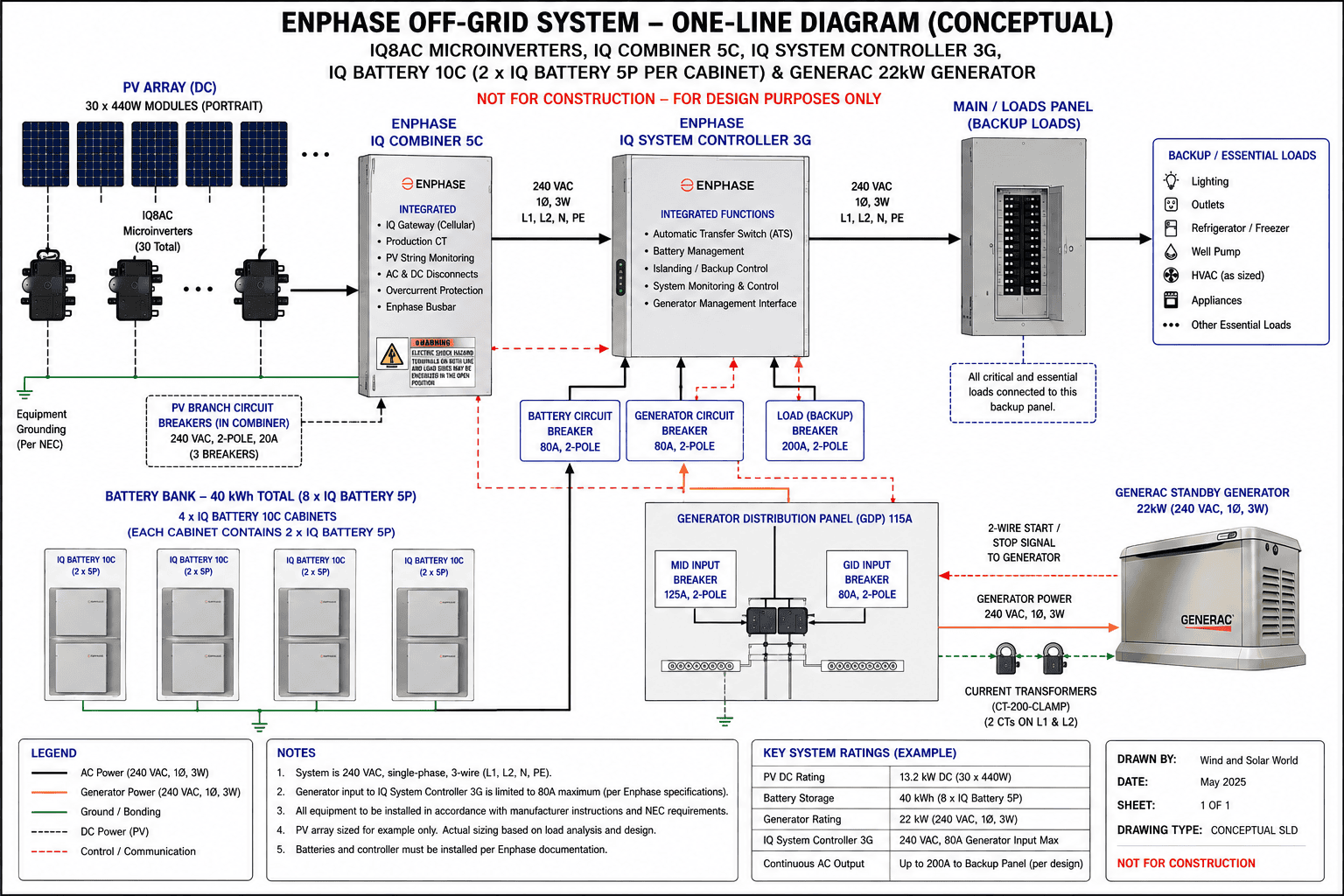
Example Only
Battery Storage Changes What Off-Grid Solar Can Do
Battery storage is what allows solar energy generated during one part of the day to be used when the sun isn’t shining.
Modern battery systems also provide sophisticated monitoring and energy-management capabilities that were unavailable with many older off-grid installations.
The correct battery capacity depends heavily upon the customer’s electrical consumption.
Rather than starting with a predetermined battery size, we look at the loads the system must actually operate.
That can include:
- Heating and cooling equipment
- Refrigerators and freezers
- Well pumps
- Lighting
- Cooking appliances
- Electronics and communications
- Shop or farm equipment
- Garage loads
- Other significant electrical equipment
Understanding those loads is one of the most important parts of designing an off-grid system.
Energy Efficiency Can Save Thousands of Dollars
With an off-grid home, reducing consumption can sometimes be considerably less expensive than adding enough solar and battery capacity to supply an inefficient load.
Heating is an excellent example.
Using stored electricity for large resistance-heating loads can require substantial battery and solar capacity. Depending upon the property, propane or another energy source may make more economic sense for certain high-energy loads.
The same principle applies to appliances, water heating, air conditioning and other equipment.
Before sizing an off-grid system, Wind and Solar World can work with the property owner to identify major loads and determine where energy-efficiency improvements or alternative energy sources could reduce the required solar and battery capacity.

Start With the Loads—Not the Number of Solar Panels
There is no single “standard” off-grid solar package that is appropriate for every North Dakota property.
A good design begins with questions such as:
How much electricity will the property use each day?
What is the largest electrical load?
Which loads might operate simultaneously?
How much overnight battery capacity is required?
How many days of poor solar production should the system accommodate?
Which loads are essential and which can be temporarily reduced?
How much generator operation is acceptable?
Once these questions are answered, the solar array, batteries, controls and generator can be sized as an integrated system.
For a new home, this process can be especially valuable because energy decisions can be incorporated before construction is complete.
Utility Extension vs. Off-Grid Power
If your utility has quoted a substantial amount to bring electricity to your property, don’t automatically assume extending the grid is your only practical choice.
Get the utility proposal in writing and compare it with a properly designed independent-energy system.
For example, if utility service requires a $73,000 upfront extension, the relevant question isn’t simply:
“Can I build an off-grid solar system for less than $73,000?”
The better question is:
“Over the period I expect to own this property, what will it cost me to extend and purchase electricity from the grid compared with owning and operating my own energy system?”
That analysis can produce very different results depending upon the home’s energy consumption, utility rates, generator fuel requirements, financing, equipment selection and expected ownership period.
Sometimes extending utility power will still be the better economic decision.
In other situations, investing in solar generation, batteries and backup power may be the more attractive option.
We believe customers should see those numbers before making the decision.

Off-Grid Doesn't Have to Mean Giving Up Modern Conveniences
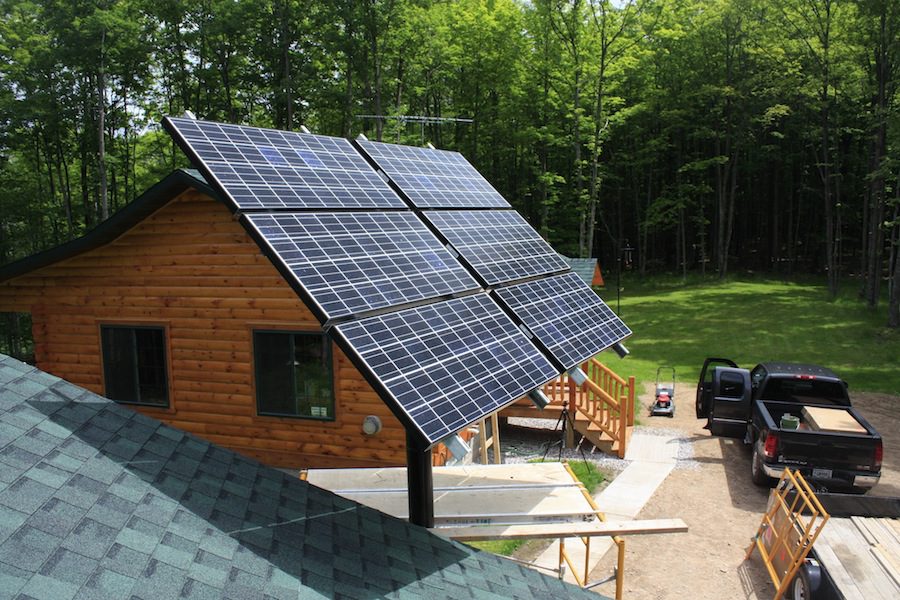
An appropriately designed system can support a modern home.
The key word is designed.
A customer planning an off-grid property should not have to guess how many panels or batteries are required. We can evaluate anticipated consumption and major loads before recommending equipment.
For new construction, involving us early can also help identify opportunities to reduce electrical demand before equipment selections and construction decisions are finalized.
That can result in a smaller and less expensive energy system without substantially changing how the homeowner lives.
More Than Solar Panels
Wind and Solar World has been installing renewable-energy systems since 2007.
Our approach to off-grid power is based on integrating the different components needed to produce dependable electricity:
Solar generation + Enphase microinverters + Enphase battery storage + Enphase system controls + generator support
The result is a complete energy system designed around the property and the people who will actually use it.
We provide renewable-energy solutions for homes, farms and businesses throughout North Dakota and surrounding areas.
Considering an Off-Grid Property?
If you’re building a home, farm or business and have received a high quote to extend utility service, contact Wind and Solar World before making the final decision.
Send us your utility-extension quote, building plans and information about the electrical equipment you expect to use.
We can evaluate the property, estimate the loads and determine whether an off-grid or energy-independent system deserves serious consideration.
Request a Quote
Get Started Today
When you are ready to maximize your savings, let our team provide you with a customized quote. We’ve been serving residential and commercial clients in North Dakota since 2007, marked by our exceptional workmanship, seamless installation process, and excellent customer service.
Let us help you cut thousands of dollars in electricity costs today. Take advantage of our free consultation and discover why our best-in-class solar panels are a smart investment for a sustainable future.
Authorized Clean Energy Dealer and Installer of Generac Power Systems
Wind & Solar World sells, installs, and services the Generac PWRcell line of clean energy backup products. Contact us for details.